

Ever wondered how your orchid is grown? How long does it take to grow an orchid?
Tissue Culture
- Commercially grown Phalaenopsis begin their lives in a sterilised laboratory as microscopic pieces of plant tissue.
- These tissue clusters are cultured in petri dishes containing a nutrient-rich agar jelly.
- Plant hormones in the agar allow the cell clusters to multiply, but prevent them from growing any leaves or roots.
- Once the cell clusters have been split the desired number of times, they are put into static flasks.
- The clumps of cells then begin to develop roots and leaves.
- The resulting plantlets will be genetically identical to the mother plant from which the node was taken.
Young plants (28°C)
- When the young plants reach a leaf span of about 5cm, they are ready to be taken out of the flasks and transplanted into new growing media.
- The plantlets are transplanted into mini-plugs and then put into a greenhouse.
- The temperature and humidity are kept high to stimulate leaf and root development.
Potted Hot Phase (28°C)
- When the young plants reach the correct size, they are transplanted into pots.
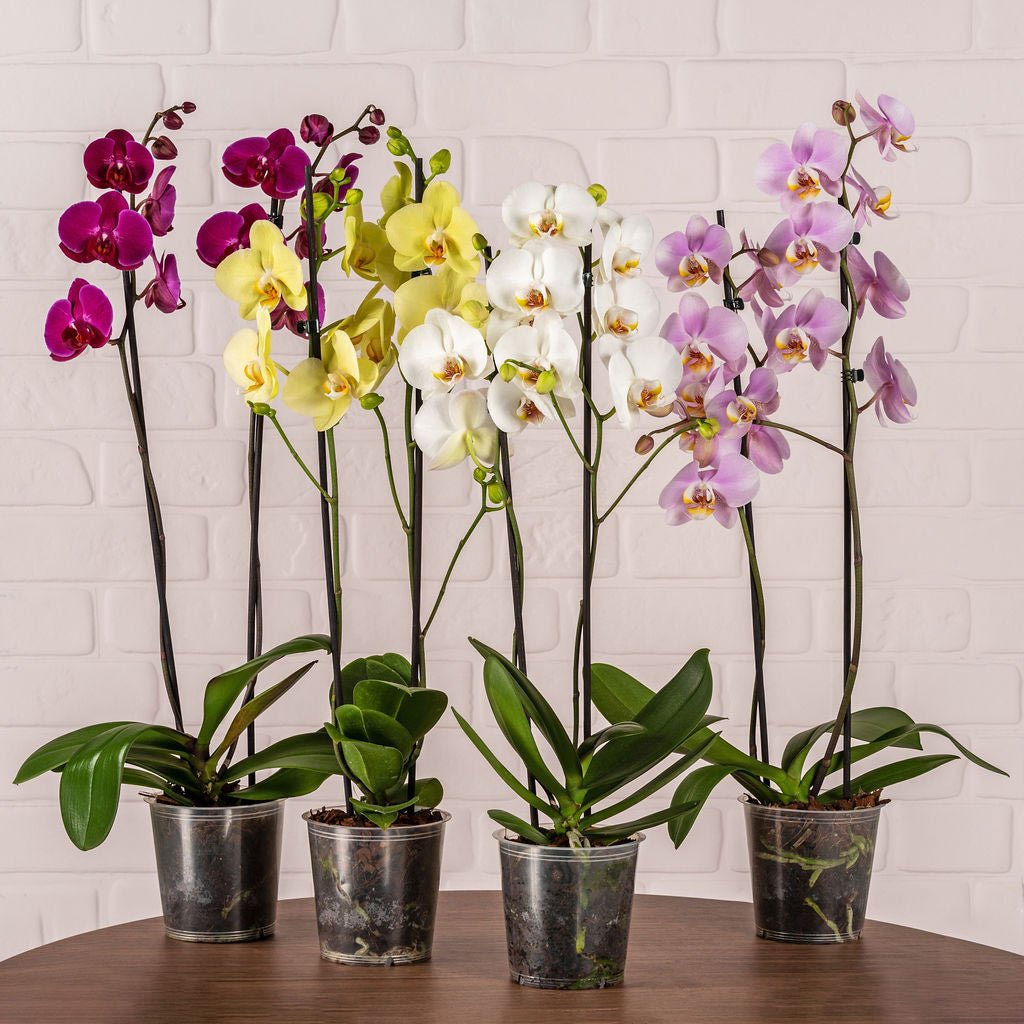
- The pots are made out of clear plastic to allow light to reach the root system.
- The pots are filled with bark to ensure the root system drains well and is aerated.
- At first, the pots are placed very close together to maximise space efficiency.
- When the leaves reach a certain diameter, a robot picks up the potted plants and re-spaces them at a lower density. This is to ensure the plants have enough light and space to continue to grow at a maximum rate.
Potted Cool Phase (19°C)
- The plants are now moved into a different part of the greenhouse – the cool zone.
- The drop in temperature triggers a stress response in the plants, causing them to switch from their vegetative growth phase to a generative growth phase: flower initiation.
- This sudden change in environment ‘tricks the plants into thinking’ that their life might be coming to an end, essentially forcing them to complete their natural lifecycle by reproducing.
- In the cool zone, tiny flower spikes will begin to emerge from the leaf axils of the plants.
Spike Development and Flowering (22°C)
- After several weeks in the cool zone, the plants are moved into a slightly warmer area to encourage growth of the new flower spikes and flower buds.
- When the spike reaches a certain height, the flower buds begin to develop.
- A few days before the flower buds open, the spikes are attached to a stake in order to keep them upright.
- After the flowers open the plants are packaged and sold.